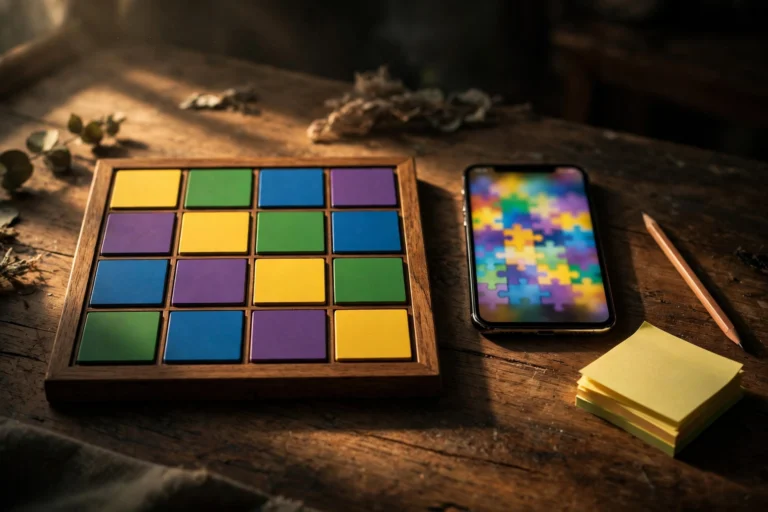
You play Connections by sorting 16 words into 4 groups of 4 words that share a hidden link, and you lose the game on your 4th wrong guess. The New York Times (NYT) publishes one new board every day at midnight Eastern Time (ET). No download, no sign up for the daily puzzle, and no timer counting you down. One board, four hidden categories, four mistakes. That spare design hides a nasty streak, and the purple group causes most of it.
This guide teaches the rules first, then walks through a full example board, then gives you 7 habits that cut mistakes. Every example board in the guide is a practice board written for teaching. Real puzzle answers never appear here, because the guide exists to make you better at the game, not to hand you a finished grid.
What Is NYT Connections?
Connections is a daily word grouping game from NYT Games, edited by Wyna Liu, launched in June 2023. Wyna Liu built the game around a single observation: English words carry more than one meaning, and a g/ood puzzle can hide inside that overlap. Connections became the second most played NYT game after Wordle within its first year. Players share results as a grid of colored squares, and the shared grid shows the order of solved groups plus every mistake.
A puzzle is called by its number, not only by its date. Puzzle #1,000 appeared in March 2026, and the daily count passed #1,230 in October 2026. Each number matters to regular players, because streaks attach to unbroken daily runs. Miss a day and the run ends. Finish all four groups and the run survives, even on a day when purple costs you 3 mistakes and a lot of pride.
Three facts explain the grip of the game on its players:
- One board per day creates scarcity, and scarcity creates a daily habit.
- Four mistakes create pressure without a clock, so the tension feels fair.
- Wordplay creates arguments, and players love arguing about whether a purple link was genius or unfair.

The Rules, Step By Step
The rules of Connections fit in 6 steps: read 16 words, pick 4, submit the guess, and repeat until 4 groups lock or 4 mistakes run out. Learning how to play Connections takes two minutes. Playing well takes longer, and the gap between those two facts is the whole game.
- Read the board first. The grid shows 16 words in 4 rows. Read every word before tapping anything, because the first pattern you spot is often a planted trap.
- Select 4 words. Tap 4 words that share a link you can name in a short phrase, phrases like fruits, colors, verbs or words that follow “black.”
- Press Submit. The 4 words lock into a colored row with the category name shown, if the guess is correct.
- Take the mistake. A wrong guess costs 1 of your 4 mistakes, if the 4 words do not match one hidden group.
- Watch for One Away. The game displays a “One Away” message, if exactly 3 of your 4 words belong to one group. One word in your selection is wrong, and the other 3 are right.
- Finish or run out. Solve all 4 groups to win the day. The board reveals every answer and ends the game, if your mistakes reach 4 first.
Two buttons sit under the grid. Shuffle rearranges the 16 words without changing any group, and Shuffle costs nothing, so use the button whenever the board feels frozen. Deselect All clears a selection that no longer convinces you. Neither button touches your mistake count.

What The Colors Mean
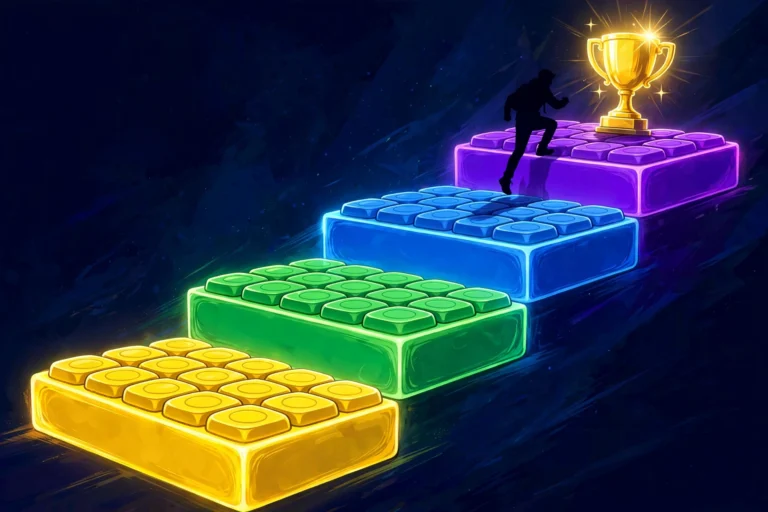
The colors rank difficulty: yellow is the most direct group, green adds a twist, blue needs knowledge, and purple hides wordplay. A color appears only after you solve its group, so nobody can hunt by color in advance. Experienced players still think in colors while solving, because color thinking predicts where the traps sit.
| Color | Difficulty | Type Of Link | Example Of The Link Style |
|---|---|---|---|
| Yellow | Straightforward | Plain meaning | Four synonyms or four members of one family, like fruits |
| Green | Medium | Meaning with a twist | A category with one odd member, like things that are sticky |
| Blue | Hard | Knowledge and trivia | Movie titles, band names, terms from one field |
| Purple | Trickiest | Wordplay | Words that take the same word before or after them, like ___ cake |
Read the table as a warning system, not a label set. A group that feels like yellow but contains one shaky word is usually blue or purple wearing a costume. Puzzle #1,230 made the point well: 3 of the 4 groups looked friendly, and the purple group hid inside a two word phrase pattern that most players saw only after 2 mistakes. Color discipline protects you in exactly that spot. Hunt the direct group first, bank it, and let the harder colors show themselves on a smaller board.
A Worked Example Board, With The Decoys Explained
A worked example teaches faster than rules alone, so study the 16 practice words below and find the 4 groups before reading the solution. The board is invented for this guide. Groups on real boards work the same way, only meaner.
Practice board: APPLE, BANANA, MANGO, PEACH, RED, PINK, BLUE, ORANGE, BILL, MARK, JACK, CHUCK, PAN, CUP, CHEESE, FRUIT.
Work through the board the way a strong player does. APPLE, BANANA, MANGO and PEACH name fruits, and that group is yellow: plain meaning, no trick. ORANGE begs to join the fruits, and ORANGE is the first decoy, because ORANGE belongs with RED, PINK and BLUE in the green group of colors. Notice the cost of the trap. Submitting ORANGE with the fruits burns a mistake and teaches you nothing about the remaining board.
Twelve words remain after the fruits lock. PAN, CUP, CHEESE and FRUIT look scattered, and scattered leftovers often signal purple. Test each word against a partner word: PANCAKE, CUPCAKE, CHEESECAKE, FRUITCAKE. The 4 words share one follower, cake, so the purple group is words that come before “cake.” FRUIT is the second decoy on the board. FRUIT pulled you toward the fruit group at the start, and FRUIT belonged to purple all along.
Eight words remain. BILL, MARK, JACK and CHUCK read as 4 men’s names, and that shared second life makes the blue group: common words that double as first names. BILL also means a banknote and a beak, which is exactly why blue groups feel slippery. The green colors group closes the board: RED, PINK, BLUE, ORANGE. Two decoys guarded two different groups on one small board. Real NYT boards run the same play with harder vocabulary.

How To Play Connections And Win More Often: 7 Habits
Winning more often comes from process, not vocabulary: bank the obvious group, name every category out loud, and spend mistakes like money. Vocabulary grows on its own across 100 daily boards. Process works on day one. The 7 habits below are ordered the way a solve unfolds, from the first read to the final guess.
- Read all 16 words twice before the first tap. The first read shows you words. Your second read shows you relationships, and relationships solve boards.
- Bank the yellow group first. A locked group removes 4 words and calms the board, and a calm board exposes decoys that a full board hides.
- Name the category in one short phrase before submitting. A group you cannot name is a group you do not actually see. Guessing on a feeling costs mistakes, and feelings lie on decoy boards.
- Quarantine every double agent. Words with two strong homes, like ORANGE and FRUIT on the practice board, sit out the early guesses. Solve around the double agents and their real group identifies itself.
- Treat One Away as a one word problem. Swap only the weakest word in the selection, if the One Away message appears. Changing all 4 words throws away 3 correct answers.
- Shuffle on a schedule, not on a whim. Press Shuffle after every solved group and after every mistake. Fresh rows break the false pattern your eyes had memorized.
- Save one mistake for purple. Stop guessing at 3 mistakes and study the leftovers as wordplay, if purple is still open. Say the words out loud, add partner words before and after them, and test sounds, not meanings.
Habit 4 wins more games than any other habit on the list. Most lost boards die the same way: a player forces a decoy into a friendly group, burns 2 mistakes, then rushes the rest. Slow solves beat fast solves. The game has no timer, and your streak does not care whether the board took 40 seconds or 9 minutes.

How To Play Connections On Phone And Computer
You play the official daily game free in a browser or in the NYT Games app, and the board plays identically on phone and computer. Search results and app stores carry dozens of clone games with similar names. Clones reset your streak data and bury the real puzzle under ads, so use the official source. The official game lives on the NYT Games site and inside the NYT Games app on iPhone and Android.
Phone play suits the game. The grid fits one screen, taps replace clicks, and a solve fits inside a coffee order. Computer play gives you a bigger board and an easier second look at long words. Your result grid copies the same way on both: solve, tap Share, and paste the colored squares anywhere. A subscription to NYT Games adds the full archive and the other games, while the daily Connections board itself stays free to open.
One habit protects phone players. Screenshot your board before the last guess, if you sit on 3 mistakes with 2 candidate groups. The screenshot costs nothing, and reviewing the frozen board beats guessing from memory after a loss.
Common Mistakes New Players Make
New players lose boards in 4 repeatable ways: guessing before reading, trusting the first pattern, ignoring One Away, and treating purple as a meaning group. Every way on the list is fixable in one week of daily play.
- Guessing before reading. A first tap inside 10 seconds usually targets a planted pattern. Read twice, tap once.
- Trusting the first pattern. Editors place the loudest false group where your eyes land first. The loud group is bait on roughly half of all boards.
- Ignoring One Away. One Away hands you a 3 out of 4 answer. Players who restart the whole selection convert a near solve into a fresh gamble.
- Hunting purple by meaning. Purple hides in sound, spelling and partner words. Meaning searches stall on purple, and stalled searches burn mistakes.
Connections Vs Wordle And Strands
Connections tests grouping, Wordle tests spelling deduction, and Strands tests theme hunting inside a letter grid. All 3 games reset daily at midnight local time for the player, all 3 publish through NYT Games, and all 3 built their followings on shareable result grids. The skills barely overlap. A strong Wordle player deduces letters in sequence, while a strong Connections player holds 16 meanings in view at once and resists the loudest pattern. Strands sits between the two, hiding themed words inside a 6 by 8 letter grid with one spangram that spans the board.
Play order matters to streaks. Many players open Connections second, after Wordle warms up the word brain, and keep Strands for last. Pick one order and keep the order daily. Ritual sounds dull, and ritual is exactly what a 200 day streak is built on.
Frequently Asked Questions
Is Connections free to play?
Yes. The daily Connections board opens free on the NYT Games site and app. A paid NYT Games subscription adds the archive of past puzzles and the full games bundle.
How many mistakes do you get in Connections?
Four. The game ends on the 4th wrong guess and reveals all 4 groups. Finishing with mistakes unused is a clean solve, and finishing on zero is a perfect game.
What does One Away mean in Connections?
One Away means 3 of your 4 selected words belong to one group. Exactly one selected word is wrong. Swap the weakest word only, and keep the other 3 in place.
When does the new Connections puzzle come out?
Midnight Eastern Time, every day. The same moment is 9:00 AM in Pakistan during daylight saving months and 10:00 AM in winter months.
Who creates the Connections puzzles?
Wyna Liu edits Connections at The New York Times. Liu also wrote the game’s official tips, and regular players learn her decoy habits within a month of daily play.
Can you play old Connections puzzles?
Yes, with a catch. The NYT Games archive holds past puzzles for subscribers. Free players get the current day only, plus yesterday coverage and past answers on hints sites like this one.
Conclusion
The board never changes its terms: 16 words, 4 groups, 4 mistakes, one new puzzle at midnight Eastern Time. Learn how to play Connections once, run the 7 habits daily, and the colors stop surprising you within two weeks. Puzzle #1,231 went live at midnight ET today, and the spoiler-free hints for that board are waiting on our homepage in 3 levels.