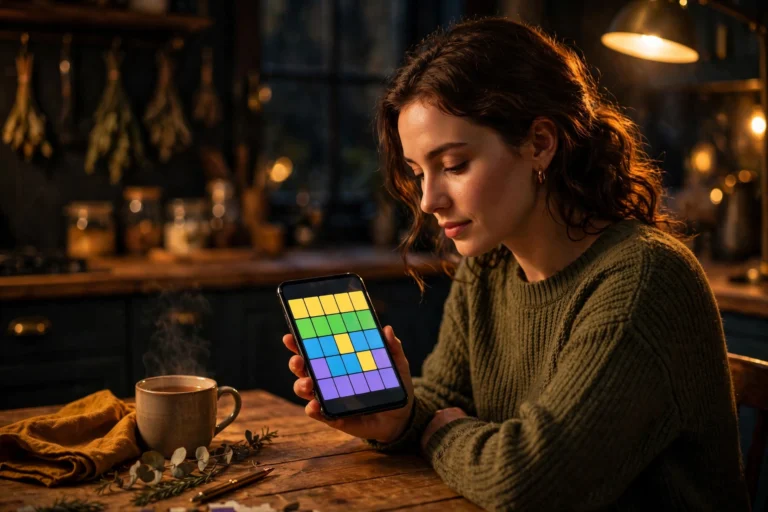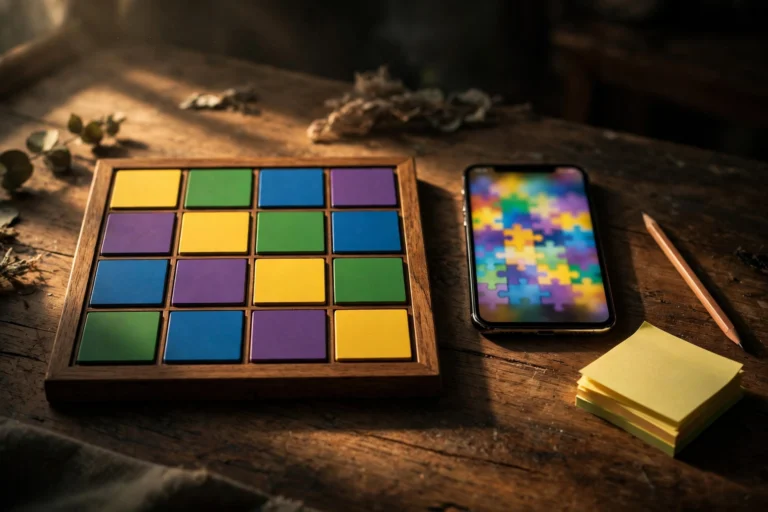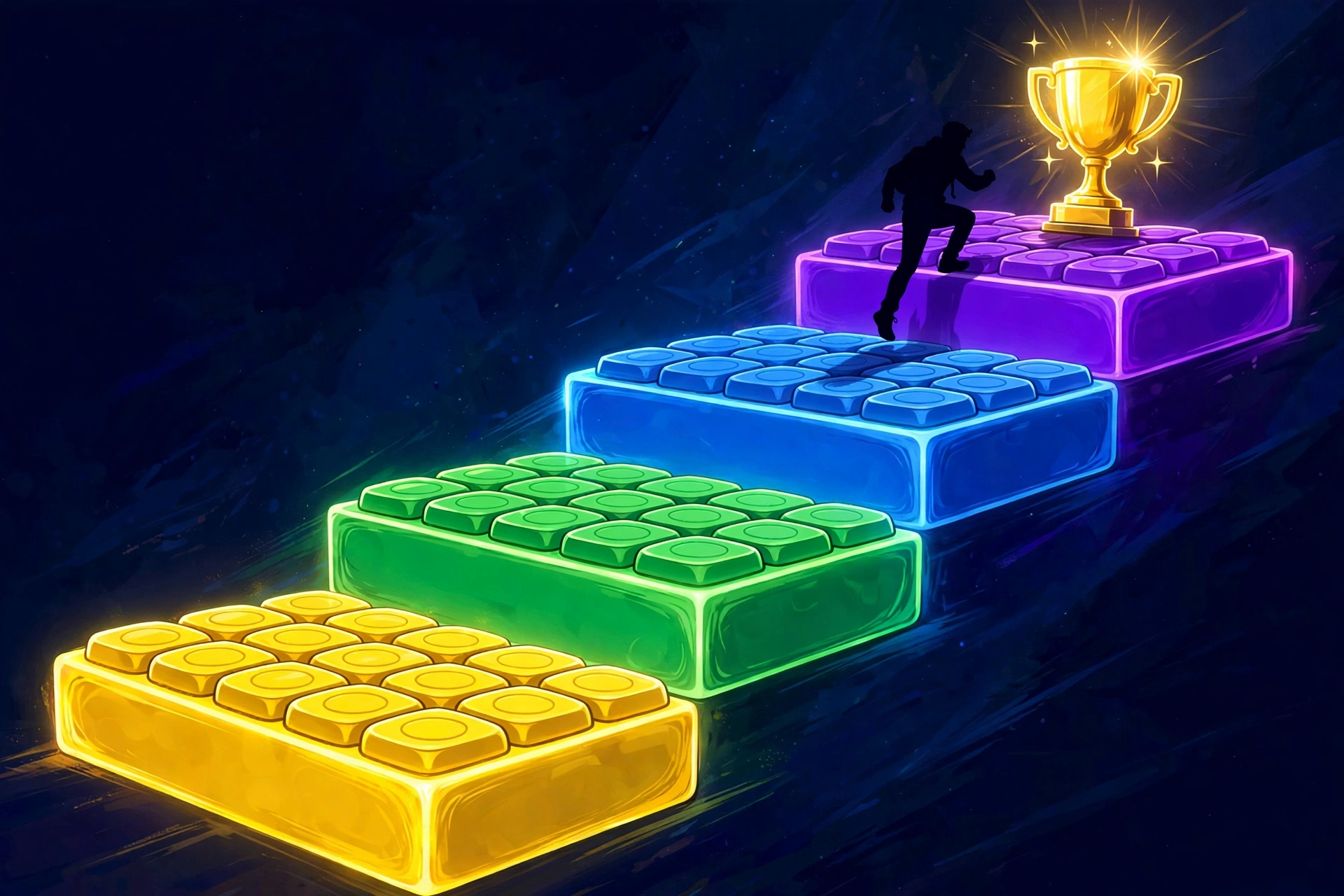
The four Connections colors are a difficulty code: yellow marks the most straightforward group, green sits one step harder, blue asks for knowledge or a sharper pattern, and purple holds the trickiest group, usually built on wordplay.
Every NYT Connections puzzle hides 16 words in four groups of four, and each group carries one of these colors. The Connections colors meaning is set by the puzzle editor before the board goes live, so the color is a grade given to the group, not a label for a topic. What the color grades is how direct the link feels once you see it.
Treat the colors as a solving order instead of a decoration and the board gets smaller in the right sequence. This guide walks through each color, grades one full real puzzle color by color, and explains why the game hides the colors until a group is solved. Follow the grading daily on our ConnectionsHints hints page.
What Do The Connections Colors Mean?
The Connections colors in order are yellow, green, blue, and purple, running from the most straightforward group to the hardest group in the puzzle.
That order never changes. Yellow is always the group the editor expects most players to find first, and purple is always the group the editor expects to fall last. Green and blue fill the middle.
Here is the point new players miss: the color grades the link, not the words. Four rare words can still be yellow if the link is plain, and four everyday words can be purple if the link plays a trick. Knowing the Connections colors meaning will not hand you a group, but it tells you what kind of link to hunt for. In puzzle #1,233 from October 26, 2026, the purple words were HALLOWEEK, HOSTED, JAWN, and PSYCHS. None of those words is hard to read. The group was purple because each one is a horror movie title with its last letter changed, and that trick stays invisible until you stop reading the words at face value.
The Four Connections Colors In Order
Read the table top to bottom and you have the full grading scale the editor uses for every puzzle, with one real group from puzzle #1,233 in each row.
| Color | Difficulty | Usual Group Style | Real Example (Puzzle #1,233) |
|---|---|---|---|
| Yellow | Most straightforward | Plain synonyms, everyday categories, common phrases | Responses To “How Are You?”: CHILLING, MANAGING, NOT BAD, SAME OLD |
| Green | A step harder | Familiar topics with a narrower or quirkier link | Kinds Of Mats: PRAYER, WELCOME, WRESTLING, YOGA |
| Blue | Knowledge based | Specialist lists, named sets, patterns you either know or miss | AKC Dog Breed Groups: HERDING, HOUND, SPORTING, TOY |
| Purple | Trickiest | Wordplay: fill in the blank, changed letters, hidden words, sounds | Horror Movies With Last Letter Changed: HALLOWEEK, HOSTED, JAWN, PSYCHS |
Two habits follow from this table. First, scan for the yellow style link before anything else, because a plain category is the fastest way to clear four words off the board. Second, read any group you cannot name cleanly as a purple suspect: if your best description is vague, the real link is probably a trick with the letters or the sounds.
The same grading runs in the Sports Edition, where the groups lean on teams, players, and sporting terms. Our Sports Edition hints use the same color order, and a sports purple is just as likely to hide a pun as a main game purple.
Yellow: The Most Straightforward Group
Yellow groups use the plainest link on the board: plain synonyms, a basic category, or a set of phrases any regular player has said out loud.
Expect links such as words that mean the same thing, items found in one room, or ways to say a common sentence. The yellow group in puzzle #1,233 was Responses To “How Are You?”, built from CHILLING, MANAGING, NOT BAD, and SAME OLD. Read those four answers side by side and the link announces itself. No specialist knowledge, no letter trick, no second meaning is doing the work.
Yellow still earns respect. Editors plant decoy words that look yellow but belong somewhere harder, and a careless first guess burns one of your four mistakes. In that same puzzle, many players tried to park TOY in the mats group because a toy can sit on a floor. TOY was blue, part of AKC Dog Breed Groups. Find the yellow style link, then test it against the whole board before you submit.
Green: Familiar, With One Small Twist
Green groups cover familiar ground, but the link is narrower than yellow, so you usually need one extra beat of thought to name it.
A green category often takes a topic you know and slices it thinner. Kinds Of Mats is a clean example. PRAYER, WELCOME, WRESTLING, and YOGA are all common words, and mats are common objects, yet the group is not “things on the floor” or “things in a house.” You have to land on the exact shared noun, mat, across four very different settings.
Green is the color where close guesses pile up. You will often spot three words quickly and stall on the fourth, because it fits the topic in a way you did not expect. WELCOME is the classic case in #1,233: plenty of players read it as a greeting and never pictured the mat under it. When the fourth word will not sit still, reread it as an object, not as an action or a greeting.
Blue: The Knowledge And Pattern Group
Blue groups turn on a named set or a body of knowledge: if you know the list, the group is easy, and if you do not, no amount of staring at synonyms will save you.
AKC Dog Breed Groups shows the shape of blue perfectly. HERDING, HOUND, SPORTING, and TOY are the official group names the American Kennel Club uses at dog shows. A dog show fan solves that group in seconds. A player who has never watched one sees four loose words, with TOY seeming to belong with games and SPORTING with athletes.
Blue also covers tight patterns that reward recognition over vocabulary: state capitals with a shared quirk or Oscar winners from one decade. If four words look like they belong to an official list, treat them as blue and test the group early. Solving blue early removes the words most likely to poison your guesses at every other color.
Purple: Wordplay Runs The Show
Purple groups hide the link inside the words themselves: a shared word before or after each answer, a changed letter, a hidden word, or a sound the words make out loud.
This is the color new players misread most. They hunt for a topic, find none, and assume the leftover words are random. They are not random. They are built on mechanics. The standard purple builds are fill in the blank groups (words that can all follow “fire” or precede “cake”), letter play (one letter added, removed, or changed), words hidden inside the answers, and homophones that only appear when you say the board out loud.
Horror Movies With Last Letter Changed in puzzle #1,233 is a textbook build. HALLOWEEK is Halloween with the final letter swapped. HOSTED is Hostel, JAWN is Jaws, and PSYCHS is Psycho. Until you test the last letters, the four words look like gibberish. After the test, the group solves itself. That is the purple rhythm: nothing, nothing, then everything at once. If the last four words make no topical sense, read them aloud, chop their first and last letters, and try a shared word on either side.
Why You Cannot See The Colors While You Solve
The board shows no colors during play because the colors are the answer key for difficulty: each group turns its color only at the moment you solve it.
Open any fresh puzzle and all 16 tiles sit in the same neutral shade. Pick four words and they highlight. Submit a correct group and the row locks in as yellow, green, blue, or purple, with the category name printed on it. Miss, and you learn nothing about the colors beyond the “one away” warning when three of your four picks share a group.
The design is deliberate. If the board showed colors up front, every player would sort by color first and the puzzle would collapse into four small, easy sorts. Hiding the grade keeps all 16 words in play at once, which is what makes decoys work: TOY can only tempt you into the mats group because nothing tells you it is blue. If you are new to the game, our guide on how to play Connections walks through the board, the mistake limit, and the shuffle button step by step.
How The Color Order Shapes Your Strategy
Use the Connections colors in order as your solving order: hunt yellow first, work green next, test blue when a named set appears, and leave purple wordplay for the shrunken board.
Start every board by scanning for the plainest link. Synonyms, obvious categories, and everyday phrases clear four words fast, and every cleared group removes decoys from the rest of the board. Four mistakes is a tight budget, and early yellow solves protect it.
Move to green by looking for the narrower version of a topic. If three words share a theme and a fourth nearly fits, test the fourth word in its less common sense before you submit. Then sweep for blue: scan the leftovers for official lists and named sets, and try those groups while the board is still full enough to confirm them.
Save purple for last on purpose. Wordplay groups get easier as the board shrinks, because elimination hands you the four words and leaves you only the link to find. Plenty of experienced players never actively solve purple at all: they clear the other three groups, take the leftovers as purple by default, and spend their thinking time on why those words connect. On a board like #1,233, once mats, replies, and dog groups are gone, HALLOWEEK and JAWN have nowhere else to hide.

The Myth: Colors Do Not Grade Every Puzzle The Same Way
The color order is fixed, but the gap between colors is not: a purple group can land softer than a blue group on the same board, and a yellow group can hide a decoy that eats a mistake.
Players talk about the colors as if each one carries a set hardness, like levels in a video game. The editor grades each puzzle on its own board. Blue in #1,233 is a pass or fail knowledge test: dog show fans found it trivial, and everyone else found it the hardest group on the board, harder than the purple. On another day, a purple built on four common phrases can feel easier than a green built on an obscure slice of a familiar topic.
Your own knowledge bends the scale too. A chef, a dog breeder, and a horror fan each solved a different “hardest” group in #1,233. Use the colors as a map of the editor’s intent, not as a promise. The one promise that holds is the order of the styles: plain links sit at the yellow end, and letter tricks sit at the purple end.
What The Share Grid Colors Tell Everyone
Your share grid prints the Connections colors in the order you solved the groups, so a grid that runs yellow, green, blue, purple shows a clean sweep from the most straightforward group to the trickiest.
Each row of the shared emoji grid repeats one color four times, one row per guess, and a perfect game shows four solid rows. A row of mixed colors records a wrong guess, and the mix shows exactly which groups your guess borrowed from. A 🟨🟨🟨🟦 row tells the whole story of a one away guess: three yellows and a blue stray, a TOY style decoy in the wrong group.
Friends who play daily read these grids like box scores. A purple row at the top means you cracked the wordplay early, which is rare. A grid that starts with mixed rows and ends with solid ones shows a comeback after early decoy trouble. The colors carry all of that in silence: a shared grid spoils nothing about the words while telling everyone exactly how your solve went.
Frequently Asked Questions
What Is The Easiest Color In Connections?
Yellow is the easiest color, and it marks the group with the most straightforward link on the board. Editors build yellow from plain synonyms, everyday categories, or common phrases, so most players find it first.
What Is The Hardest Color In Connections?
Purple is the hardest color, and it usually hides wordplay instead of a topic. Fill in the blank links, changed letters, hidden words, and homophones all live at the purple end of the scale.
What Is The Full Connections Colors Order?
The Connections colors in order are yellow, green, blue, and purple, from most straightforward to trickiest. That sequence stays the same in every main game puzzle and in the Sports Edition.
Can You See The Colors Before Solving A Group?
No, the board hides every color until the moment a group is solved. All 16 tiles share one neutral shade during play, and a correct guess is what turns the row yellow, green, blue, or purple.
Does Purple Always Mean Wordplay?
Nearly always, yes, a purple group is built on how the words look or sound rather than what they mean. A changed final letter turned Halloween, Hostel, Jaws, and Psycho into the purple group in puzzle #1,233.
Do The Colors Mean The Same Thing In Sports Edition?
Yes, Sports Edition grades its groups with the same yellow to purple scale, and the Connections colors meaning is identical there. The topics change to teams, players, and sporting terms, and our ConnectionsHints homepage tracks both puzzles every day.
Conclusion
The colors are the editor talking to you after the fact: yellow confirms you found the plain link, and purple confirms the link was hiding inside the words all along.
Play them in order and the board behaves. Scan for plain links, slice topics thinner for green, test named sets for blue, and let the leftovers confess their wordplay at the end. A purple group in the NYT Connections puzzle is always built from a change to the words themselves: a letter swapped, a word added, a sound shared, or a term hidden inside the answer.