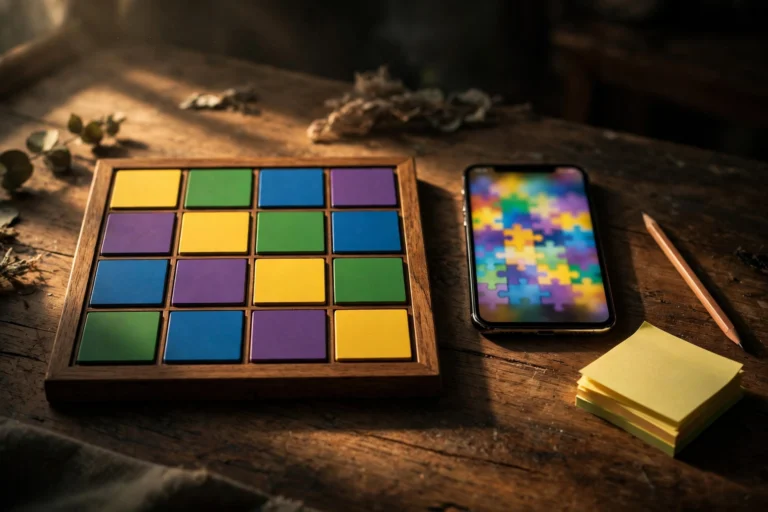
Custom connections are fan-made versions of the daily New York Times game, built by players who want a board tuned to their own friends, family, or classroom. You pick the sixteen words, you set the four categories, and you control how sneaky the purple group gets. Anyone can open a free connections maker, type in four groups of four, and share a link within about fifteen minutes.
That freedom is also the trap. Plenty of homemade boards fall apart because two groups overlap, or because a fifth word sneaks into the wrong category. This guide walks through the tools that work, the build order that keeps a puzzle fair, and the mistakes that quietly ruin an otherwise good board. If you want a refresher on how the official game plays before you build one, our walkthrough on how to play Connections covers the rules and the color ladder.
What Are Custom Connections Puzzles?
A custom Connections puzzle is an unofficial board that copies the official format: sixteen words, four hidden groups of four, and one intended solution. Fan makers host these boards for free, and players open them through a shareable link instead of an app. None of these sites belongs to The New York Times, and the daily official puzzle still lives on the NYT Games site and app.
People build them for birthdays, weddings, office parties, and classrooms. Teachers turn spelling lists and history terms into boards their students race to solve. Group chats run weekly puzzle swaps, where each person authors one board and solves everyone else’s. A good homemade board feels personal in a way the daily game cannot, because every category can nod to a shared joke, a hometown, or a fandom.
The format travels well because the rules fit in one sentence. Solvers already know the rhythm from the daily game, so your board needs no instructions beyond the link itself.
The Best Connections Maker Tools
Four free tools handle nearly every homemade board, and Custom Connections by Claire Wang is the fastest of the four. Each one works in a browser, and none of them asks you to write code. Pick based on how you plan to share the finished puzzle.
Custom Connections by Claire Wang
This maker keeps things as close to the official look as possible. You give your game a title, then type a category name and its four items for each of the four groups. The colors match the New York Times version, so a finished board feels instantly familiar. Once you copy the game link at the bottom, you can still fix a typo later, and the same link keeps working after the edit.
Swellgarfo’s Create a Puzzle
Swellgarfo’s builder at connections.swellgarfo.com follows the same simple pattern and has served fan makers for years. You fill in sixteen words and four category labels, and the tool generates a playable page with the standard four-mistake limit. First-time builders often start here because the form never asks for anything beyond the words themselves.
Connections+ Create
Connections+ pairs its maker with an archive of past official puzzles and a public community library. Its Create flow asks for a game name, an author name, four category descriptions, and your sixteen entries. Finished boards can stay private for a small circle, or you can publish them to the Community section where strangers solve and rate them. That public shelf makes Connections+ the best pick when you want an audience beyond your own group chat.
Flippity Group Game
Flippity builds its Group Game from a Google Sheets template, a setup teachers already know from its other classroom tools. You paste your categories into the sheet, publish it, and share the generated link. Flippity forgives far more wrong guesses than the official game’s four, which suits younger solvers and first-time players. Anyone building boards for a classroom should start with this one.

How To Build A Balanced Custom Connections Puzzle
A balanced custom puzzle starts from the four categories rather than the sixteen words, and it climbs in difficulty on purpose. Work in this order and the board stays fair.
Step 1: Pick Your Audience And Theme
Decide who solves the board before you write a single word. A puzzle for coworkers can lean on office life, while a family board can raid shared holidays and inside stories. Naming the audience first keeps your trivia at the right depth.
Step 2: Write The Yellow Group First
Open with the group a solver should spot in under ten seconds. Plain categories work best here: kitchen tools, farm animals, or words for rain. Yellow sets the tone and buys your solver confidence for the harder rows. For a refresher on what each color signals, see our guide to the Connections colors explained.
Step 3: Give Green A Small Twist
Green should need one extra beat of thought. Synonyms with a catch, items from one narrow shelf, or words tied to a single hobby all fit. A solver who finds green second still feels the board opening up in order.
Step 4: Build Blue Around Knowledge Or A Pattern
Blue rewards people who know a field or spot a structure. Capitals of island nations, chess pieces, and words that gain a meaning with “sea” in front of them all live at this level. Keep the knowledge checkable: a solver should be able to confirm the group with a quick search after the reveal.
Step 5: Save Real Wordplay For Purple
Purple is where words stop behaving. Groups built on hidden letters, changed spellings, or words that precede a common partner belong here. Our deep dive on the purple category explains why the official game treats purple as the wordplay slot.
Step 6: Plant One Or Two Fair Decoys
A decoy is a word that flirts with the wrong group. Park a fifth kitchen-adjacent word near your yellow set, and solvers must weigh it against the true four. Fair decoys tempt; they never create a second complete group. Two decoys are plenty for a sixteen-word board.
Step 7: Run The Overlap Check
Read each word against all four category labels and ask where else it could land. Any word that fits two groups cleanly breaks the board, because the game promises exactly one solution. Swap the offender out, then scan for accidental sets: five words sharing a trait means one group is wrong.
Step 8: Test-Solve Before You Share
Hand the link to one person who has never seen your categories. Watch where they stall and which wrong groups they try. A stall at purple is healthy; a stall at yellow means your ramp needs rework. The dreaded one away message should show up once or twice, not on every guess.
Group Types That Work In A Custom Puzzle
Six group types carry most successful homemade boards, and mixing two or three types beats repeating one idea four times. The table below maps each type to a real example and its usual color.
| Group Type | How It Works | Example Group | Typical Color |
|---|---|---|---|
| Straight category | Four members of one plain set | LADLE, WHISK, SPATULA, TONGS (kitchen tools) | Yellow |
| Synonyms | Four words sharing one meaning | QUICK, RAPID, SWIFT, SPEEDY | Yellow or Green |
| Fill in the blank | Each word completes one phrase | PAN, CUP, CHEESE, SHORT before “cake” | Green or Blue |
| Knowledge set | Four facts from one field | KNIGHT, BISHOP, ROOK, QUEEN (chess pieces) | Blue |
| Words before a word | Each item precedes a shared partner | BLACK before BERRY, BOARD, MAIL, SMITH | Blue or Purple |
| Letter trick | A spelling pattern links the four | KNIFE, GNOME, WRECK, PSALM (silent first letters) | Purple |
Variety matters because solvers hunt by type. Once a player cracks your synonym group, they stop testing synonym sets and start testing patterns. A board built from four synonym groups feels flat by the third solve, even when each set is clever on its own.
Purple Group Ideas That Stay Fair
Fair purple groups hide a rule that any solver can verify within seconds of the reveal. Steal the shapes below and dress them in your own theme.
- Words that precede “cake”: PAN, CUP, CHEESE, and SHORT build pancake, cupcake, cheesecake, and shortcake
- Palindromes: LEVEL, RADAR, CIVIC, and KAYAK read the same backward
- Silent first letters: KNIFE, GNOME, WRECK, and PSALM each hide a letter nobody says
- Words that follow “black”: BERRY, BOARD, MAIL, and SMITH complete four everyday compounds
- Movie titles minus a letter: take one letter from a famous title and the group clicks only after the reveal
Fairness has a simple test. Read your purple rule out loud to a friend who has not seen the board. A good rule gets a groan and a nod; a bad rule gets an argument. Cut any group whose rule needs a paragraph of defense.
How To Share Your Puzzle And Play Your Friends’ Boards
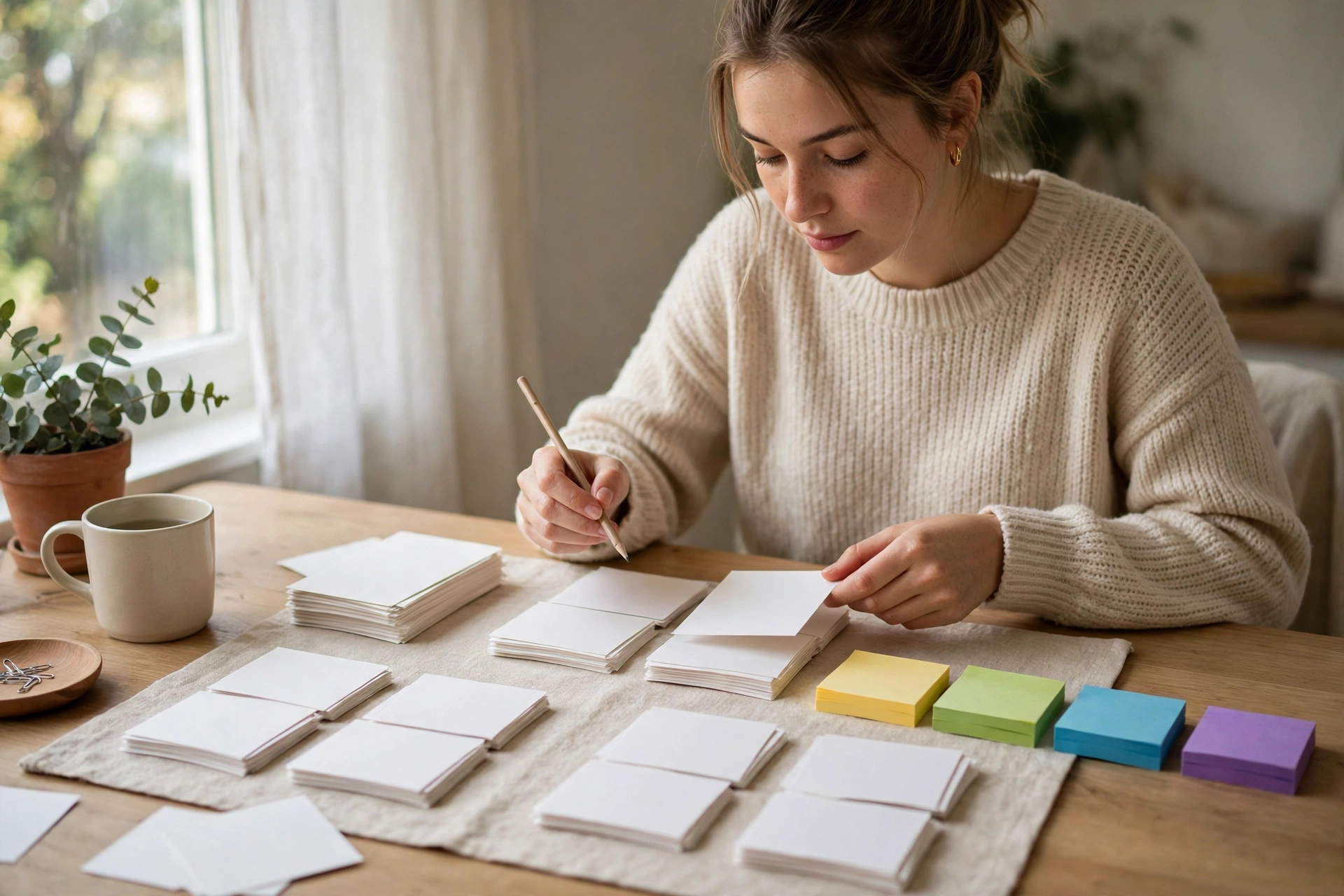
Every major connections maker hands you a link, and that link is the entire delivery system. Copy it, drop it into the group chat, and ask each solver to send back their colored grid when they finish. Those grids carry no words, so nobody spoils the board for slower players.
Set simple house rules before the first swap. Agree on whether hints are allowed, and decide if a failed board still earns a posted grid. Many groups keep a running scoreboard across a month of swaps, with the author of the hardest fair board earning bragging rights. Rotate authorship so the same person never builds twice in a row.
Playing a friend’s board deserves the same care you give the daily one. Solve on the maker’s own site, since mistake limits differ between tools. Send the grid back even when the board beats you: authors learn more from failed grids than from perfect ones.
Mistakes That Make A Custom Puzzle Unfair
The most common failure is a fifth word that fits a finished group, since it hands the board two correct answers. Watch for these seven errors before you share any link.
- Two groups built on the same idea. Back-to-back synonym sets bore solvers and blur your ramp.
- A word that fits two groups equally well. Overlap breaks the one-solution promise at the heart of the format.
- Wordplay nobody can check. Inside jokes without a visible rule feel like cheating to everyone outside the joke.
- An upside-down ramp. Obscure trivia in yellow and a plain set in purple makes the colors meaningless.
- Category titles that lie. A label should describe its group honestly once revealed, never point at a fake theme.
- Sixteen words, zero decoys. Boards without a single tempting wrong turn solve in a straight line and feel flat.
- No test solve. Makers who skip the cold read ship their own blind spots straight to their friends.
Fix most of these with one habit: reread your sixteen words as a stranger. Fresh eyes catch the fifth wheel, the double fit, and the group only you could ever see. Ten quiet minutes of checking beats a week of group-chat complaints.

Frequently Asked Questions
Are custom Connections puzzles official New York Times puzzles?
No. Fan-made boards copy the format, but they carry no link to the newspaper. The official daily game appears only on the NYT Games website and app, edited by Wyna Liu.
What is the best free connections maker for beginners?
Custom Connections by Claire Wang suits most beginners because the form asks only for a title, four category names, and sixteen items. Its colors match the official game, and edits keep the same link.
How many words do I need to make your own connections game?
You need sixteen words split into four groups of four, plus a short label for each group. Most makers also ask for a puzzle title, and some request an author name.
Can I edit my puzzle after I share the link?
Yes, on Custom Connections your edits save under the same link, so friends keep opening the corrected board. Other tools differ, so check the maker’s edit option before you send the link widely.
How do I make my custom puzzle harder without making it unfair?
Move wordplay into the purple group and plant one decoy word that nearly fits another set. Keep exactly one solution, and let a friend test-solve the board before you share it.
Can I sell puzzles I build with a connections maker?
Treat homemade boards as personal play only. The Connections name and format belong to The New York Times, and the fan makers build their tools for free sharing among friends, classes, and communities.