The Connections purple category is the hardest group in every NYT Connections puzzle, and it is built on wordplay instead of meaning. Yellow groups synonyms. Green groups a clear set. Blue groups specific knowledge. Purple groups words by how they look, how they sound, or what they become when you add, remove, or change a letter. You aren’t hunting for a topic in purple. You’re hunting for a trick. Puzzle #1,233 proves the point: its purple group was Horror Movies With Last Letter Changed, built from HALLOWEEK, HOSTED, JAWN, and PSYCHS. Each one is a famous horror title with the final letter swapped, from Halloween, Hostel, Jaws, and Psycho. Once you see the swap, the group solves itself, and the gap between noise and clarity is exactly what purple is designed to create.
What Is The Connections Purple Category?
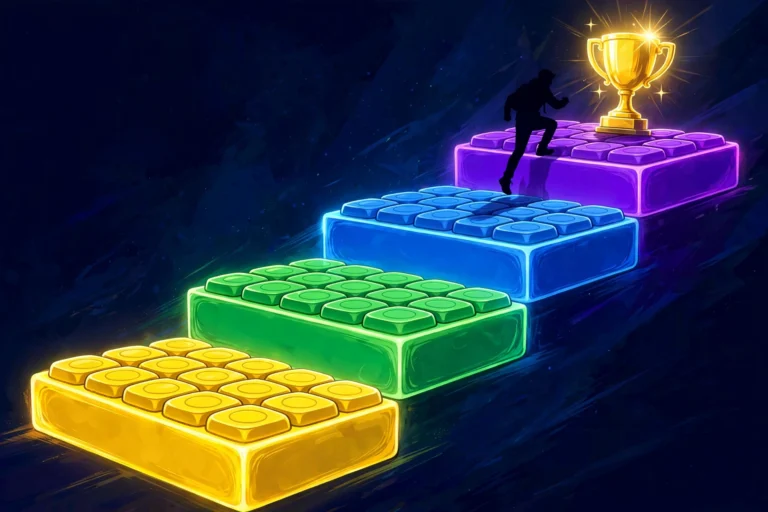
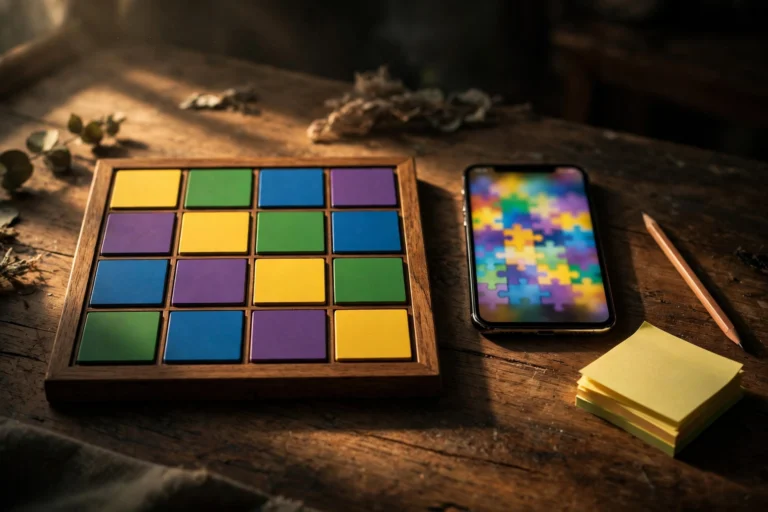
The Connections purple category is the fourth and hardest group in the daily grid, and the game colors it purple to signal the highest difficulty. NYT Connections sorts its four groups by difficulty, running from yellow as the easiest, through green and blue, to purple as the hardest, and our guide on how to play Connections lays out the full color system. Purple keeps its promise by refusing plain definitions. A yellow group like Responses To “How Are You?” from puzzle #1,233 works because CHILLING, MANAGING, NOT BAD, and SAME OLD all do the same job in conversation. Purple never offers that comfort. Its connection hides inside the words themselves, inside their letters, sounds, prefixes, suffixes, or partners. Finding purple on purpose, instead of by elimination, is a learnable skill. Editors reuse a small set of wordplay patterns, and this guide names those patterns one by one so you can test them in order.
Why Is Purple Always Wordplay And Not A Topic?
Purple is always wordplay because the editors reserve the hardest slot for connections that meaning alone cannot reveal. Wordplay groups defeat the topic question on purpose, since their members often belong to four unrelated topics. HALLOWEEK is not really about a week, and HOSTED is not really about hosting anything. Puzzle #925 used the same logic in reverse with Colours Minus Last Letter, grouping BROW, CYA, PIN, and WHIT. Read literally, those are a forehead, a farewell, a fastener, and a tiny amount. Read as brown, cyan, pink, and white with the last letter cut, they form a perfect set. Sound can carry the trick instead of spelling. Puzzle #1,110 built its purple group on Starting With Bird Homophones, where CRANIUM starts with the sound of crane, CROQUETTE with crow, DUCTILE with duck, and HOCKEY with hawk. Structure gives you everything in these groups, which is why experienced solvers stop asking what purple words mean and start asking what purple words do.
The Main Purple Archetypes That Repeat
The Connections purple category repeats eight main archetypes: fill in the blank, partner words, homophones, hidden words, letter added, letter removed, letter changed, and words that start with another word. Editors rotate these patterns with fresh content, so the surface changes daily while the machinery stays the same. The table below lists each archetype with a real published group and the fastest way to spot it on a live board.
| Archetype | Real Example Group | How To Spot It |
|---|---|---|
| Fill In The Blank | ___ Tackle (DEFENSIVE, HORSE-COLLAR, RIGHT, SLIDE) | Try one shared word before or after all four entries |
| Partner Word After | Words That Follow “Hot” (DOG, FOOT, HEAD, LINE) | Test common partners such as dog, line, and head against every odd word |
| Homophones | Where, Wear, Ware, Weir As Sound Alikes | Say each word out loud and listen for a shared sound |
| Starts With Another Word | Words Beginning With Synonyms For “Desire” (CRAVEN, DESIREE, NEEDLE, WANTON) | Read only the first three or four letters of each long word |
| Hidden Word Inside | Words Containing Parts Of The Face | Scan the middle of long words for a short buried word |
| Letter Removed | Colours Minus Last Letter (BROW, CYA, PIN, WHIT) | Add one letter to the end or start and check for a clean set |
| Letter Changed | Horror Movies With Last Letter Changed (HALLOWEEK, HOSTED, JAWN, PSYCHS) | Swap the final letter of strange words and test famous titles |
| Letter Missing At Start | Animals Minus Starting Letter (ANTHER, EASEL, HARK, LAMA) | Put a letter back in front and look for animals or objects |
Patterns in the table overlap on real boards, so treat the archetypes as a checklist rather than as sealed boxes, and run the checks in order, because the earlier checks take seconds while the later ones take real effort. Puzzle #954 rewards the starts with check almost instantly: CRAVEN, DESIREE, NEEDLE, and WANTON look unrelated until their openings spell crave, desire, need, and want.
Fill In The Blank Groups
Fill in the blank groups ask four words to share one missing partner, written in the category name as a blank line. Sports Edition puzzle #763 states the pattern openly with ___ Tackle, grouping DEFENSIVE, HORSE-COLLAR, RIGHT, and SLIDE. Each entry completes a real term: defensive tackle, horse-collar tackle, right tackle, and slide tackle. You can study that exact board in our Sports Edition hints, where the same color rules apply on a sports grid. Pick the strangest word on the board, then say it with common partners attached: fire, snow, basket, base, book, cake, house, work. HOSTED from puzzle #1,233 fails every partner test, which tells you within seconds that the blank isn’t today’s trick. One caution applies every time: a word can accept a partner and still belong elsewhere, so the blank only counts when all four words accept the same one.

Sound Based Groups
Sound based purple groups connect words by pronunciation, so they stay invisible until you read the board out loud. Your eyes see CRANIUM as anatomy and HOCKEY as a sport, while your ears hear crane and hawk hiding at the front of each word. Puzzle #1,110 collected four of those openings, pairing CRANIUM and CROQUETTE with DUCTILE and HOCKEY under Starting With Bird Homophones. Full homophone groups push the trick further: where, wear, ware, and weir share one sound and nothing else, which is why editors love the set. Reading the whole board aloud once, slowly, costs you ten seconds. Skipping that read can cost you the puzzle, because sound groups almost never reveal themselves twice to the eyes alone.

Letter Play Groups
Letter play groups are built by adding, removing, or changing a letter in each word, and the category name usually states the operation once you find it. Puzzle #1,233 changed one letter per word, turning Halloween, Hostel, Jaws, and Psycho into HALLOWEEK, HOSTED, JAWN, and PSYCHS. Puzzle #925 removed one letter per word, cutting brown, cyan, pink, and white down to BROW, CYA, PIN, and WHIT. HOSTED sits one letter away from a famous film, and CYA sits one letter short of a color. Slightly wrong words are purple calling cards, so flag them before you solve anything else. Editors choose base sets you already know, like horror films, colors, animals, or countries, because the trick must feel fair after the reveal. Take each odd word, add a letter to the front, add one to the end, then swap the last letter for common alternatives. Three quick operations per word expose most letter play groups, and the full walkthrough of the October 26 board in our daily hints for puzzle #1,233 shows the swap working word by word.
Hidden Word And Structure Groups
Hidden word groups bury a short complete word inside each longer word, and structure groups sort words by a shared formal feature such as opening letters or palindromes. Editors have hidden body parts, animals, and first names inside longer entries, so a word like SLIP can carry LIP inside it while longer words hide EAR or EYE. Openings matter even more often. Puzzle #954 grouped CRAVEN, DESIREE, NEEDLE, and WANTON purely because each one starts with a synonym for wanting: crave, desire, need, and want. Endings get the same treatment on other days, with surnames, chemical symbols, and Roman numerals all serving as hidden tails. Palindromes form the rarest structure group, collecting words that read the same backward and forward, and a true palindrome never needs interpretation. Check both ends of every long word before you judge it meaningless.

How To Solve Purple Without Wasting Mistakes
You solve the Connections purple category fastest by solving yellow and green first, then running the archetype checklist on the words that remain. Shrinking the board isn’t a shortcut around purple. It’s the method, because every solved group removes four decoys and raises the signal on the rest. Start each puzzle by taking the obvious topic groups, even when a purple idea tempts you early. Work through the checklist in a fixed order once twelve or fewer words remain. Test partner words first, then read the board aloud for sound, then inspect openings and endings, then try letter surgery on the oddest words. Hold your submits until one archetype explains exactly four words and no fifth word fits it. Editors plant a fifth fitting word on hard days, and that plant exists to eat your mistakes, so finding the impostor among five fits is the real puzzle. Today’s board is waiting on our daily Connections hints page if you want the checklist beside a live grid.
When Two Purple Ideas Fit At Once
Two purple ideas can fit the same board because editors deliberately plant a near miss beside the real group, and the correct group is the one that leaves a solvable remainder. You must also glance at the twelve words you’re leaving behind and ask whether they can still form clean groups. A purple idea that orphans an impossible remainder is wrong, however elegant it feels. Puzzle #1,233 tempts this error with its film flavor: HOSTED and PSYCHS suggest movies, JAWN suggests slang, and HALLOWEEK suggests holidays. Only the letter change reading explains all four at once while leaving three clean topic groups behind it. Preference goes to the reading with the tightest fit: an exact letter operation beats a vague resemblance every time. Editors design the real group to feel inevitable after the reveal, so trust the group you can defend word by word without stretching any single entry.
Purple In The Sports Edition
The Connections purple category follows identical wordplay rules in the Sports Edition, with sports terms supplying the raw material. Nothing about the difficulty promise changes when the grid turns to sports. Yellow stays plain, purple stays structural, and the blank, sound, and letter tricks all return. Sports Edition puzzle #763 ran the blank archetype with ___ Tackle, while puzzle #760 put baseball knowledge in the blue slot with its League Championship Series group. Purple keeps the language games, like the World Series MVP group from that same week whose names changed by one opening letter. Solvers who learn the eight archetypes on the main grid carry the full skill set to the sports grid without adjustment. Pattern recognition decides purple there, exactly as it does every morning on the standard puzzle.
Purple Traps That Burn Mistakes
The costliest purple trap is submitting a strong topic group of four that the editors split across two or more real groups. HALLOWEEK can pull you toward holidays and Halloween itself before the letter trick surfaces. PSYCHS can pull you toward minds and behavior, while HOSTED pulls toward parties and television. Each pull is a decoy the editors placed with intent. A group you cannot explain in one short sentence isn’t ready to submit, and purple explanations should name an operation, never a vibe. One away warnings deserve special respect late in a game. Two mistakes spent means the board has already told you that one of your trusted groups is wrong, and purple is usually where the error hides. Rebuild from the strangest word at that point instead of defending your first idea, because attachment to a wrong purple reading ends more streaks than ignorance ever has.
Frequently Asked Questions
Is Purple Always The Hardest Category In Connections?
Yes, purple is always the hardest of the four groups. The game orders difficulty from yellow through green and blue to purple. Purple earns the slot with wordplay that meaning cannot solve.
What Is The Most Common Purple Category Type?
Fill in the blank groups appear most often in the purple slot. Four words share one missing partner, as DEFENSIVE, HORSE-COLLAR, RIGHT, and SLIDE share Tackle in Sports Edition puzzle #763.
Can A Purple Group Ever Be A Simple Topic?
Editors almost never give purple a plain topic. Rare knowledge based sets can land there, but the slot overwhelmingly holds wordplay, letter changes, sounds, or hidden structures rather than straightforward subjects.
How Can You Spot A Purple Group Early?
Flag the words that look slightly wrong or oddly spelled. HOSTED, JAWN, and PSYCHS in puzzle #1,233 each sat one letter from a famous title, and odd words usually carry the purple trick.
Why Do Solvers Find Purple Last So Often?
Purple is usually found last because its connection hides inside letters and sounds. Topic groups reveal themselves through meaning, while purple demands a different search that most players only start after easier groups clear.
Does The Sports Edition Have A Purple Category?
Yes, the Sports Edition uses the same four colors and the same difficulty order. Its purple groups run the same wordplay patterns, including the ___ Tackle blank group from puzzle #763.
Conclusion
The Connections purple category stops being mysterious the moment you treat every strange word as a clue about spelling, sound, or structure. Eight archetypes cover the overwhelming majority of purple groups ever published, and the checklist in this guide runs through all eight in under a minute. A solver who tested partner words on Monday recognizes the blank faster on Tuesday, and the homophone that hides on Wednesday gets read aloud without prompting by Friday. The final fact is the one worth keeping beside every new grid: purple never asks what the words mean, and it always rewards players who ask what the words can do.