Every Connections puzzle looks different, yet the editor builds each one from the same small toolbox. Once you learn the handful of group types that repeat from puzzle to puzzle, connections groups stop looking random and start looking readable. You will not solve every grid in a minute, but you will know what kind of link you are hunting for.
That shift matters more than raw vocabulary. Most failed solves do not come from unknown words. They come from chasing the wrong kind of connection, such as forcing four words into a topic when the real link is a spelling trick. Readers who want the rules first can start with our guide on how to play Connections, then come back here for the pattern work.
What Are Connections Groups?
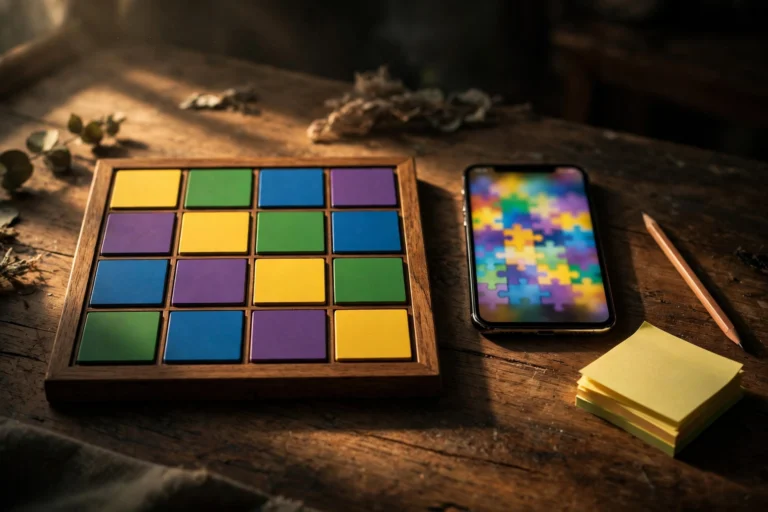
Connections groups are sets of four words tied together by one exact link, and that link follows a recognizable pattern almost every time. The New York Times puzzle, edited by Wyna Liu, gives you 16 words and asks you to sort them into four groups of four. Each group gets a name once you find it, and that name describes the link in plain words.
Look closely at those names across many puzzles and a habit appears. Group names repeat in style even when the topics change. One day the name reads like a dictionary note, the next day it reads like a riddle. Both styles come from the same short list of types covered below, and strong players learn to ask one question before anything else: what type of link could this be?
The Recurring Types Behind Connections Groups
Five types cover the large majority of connections groups you will ever meet: plain synonyms, categories of things, fill in the blank phrases, wordplay tricks, and pop culture or trivia sets. Some puzzles blend two types, and purple groups love stacking a trick on top of a topic. Still, one type leads in nearly every group, so naming the lead type is a fast way to sort a messy grid.
Type 1: Plain Synonyms And Near Synonyms
Synonym groups link four words that mean roughly the same thing. Puzzle #1227, played on October 20, 2026, opened with a textbook case: CLOSE, END, STOP and WRAP all mean to finish something. Groups like this usually hide in the yellow or green slot because the link is honest and direct.
Watch for words that share a job rather than a topic. Verbs team up often here, so test whether each word can replace the others in one sentence. Four words that fit the sentence “Please ___ the meeting” are probably a synonym group, even when they look unrelated on the board.
Type 2: Categories Of Things
Category groups collect four members of one set, such as kinds of mats, breeds of dog or items found in a park. Puzzle #1233 served a friendly example with PRAYER, WELCOME, WRESTLING and YOGA, all kinds of mats. Nobody defines those words as synonyms, yet each one completes the phrase “___ mat” in real life.
Sets like this one reward broad general knowledge over word skill. Scan the board for words that could follow the same label word, like kinds of, parts of, or types of. Finding three members quickly is common; the fourth often hides behind a second meaning, which is exactly why the editor picks it.
Type 3: Fill In The Blank Groups
Fill in the blank groups pair each word with the same missing partner, either before it or after it. Puzzle #1234 ran two of them back to back: DIVING, JINGLE, LIBERTY and TACO all sit before BELL, while BOTTOMS, JAR, PEPPER and TOWER all follow it. Same partner word, opposite directions, one very confusing board.
Say the candidates out loud with a blank in front or behind. Your ear catches these links faster than your eyes do, because phrases like taco bell and liberty bell live in your memory as sounds. Players miss this type most often when they read silently and rush.
Type 4: Wordplay, Hidden Words And Sound Tricks
Wordplay groups link words by their letters or sounds instead of their meanings. Three flavors show up again and again:
- Hidden words: a smaller word sits inside each answer, like the coin names ending CEFTAZIDIME (dime), HEADQUARTER (quarter), MONEYPENNY (penny) and PUMPERNICKEL (nickel) in puzzle #946.
- Sound swaps: each word sounds like something else, like ARIAL, BELL, DOCK and MINI, which sound out Disney names Ariel, Belle, Doc and Minnie in puzzle #1227.
- Letter changes: a known title or phrase sits behind one altered letter, like HALLOWEEK, HOSTED, JAWN and PSYCHS, horror films with the last letter changed, in puzzle #1233.
Meaning will not save you here. Read the board letter by letter, then sound by sound, before you give up on four words that refuse to share a topic.

Type 5: Pop Culture And Trivia Sets
Trivia groups gather four names or terms from one corner of culture, sports, food, film or history. Puzzle #1233 used HERDING, HOUND, SPORTING and TOY, the American Kennel Club dog breed groups, as its blue group. Blackjack supplied puzzle #902 with its purple group: BUST, HIT, SPLIT and STAND, all moves from the game also called pontoon.
Nobody knows every corner, and the editor knows it. Groups of this kind feel unfair when the topic is new to you, yet they are fair in one way: the four members usually stand out as the four most specific, name-like words on the board. Cluster the odd proper nouns and jargon first, then test whether one world contains all four.
Famous Real Groups And The Type Behind Each One
Real past groups show the five types more clearly than any definition can. Each row below comes from a published puzzle, and the type column names the pattern doing the work.
| Group Name | The Four Words | Type | Color |
|---|---|---|---|
| Finish | CLOSE, END, STOP, WRAP | Plain synonyms | Yellow |
| Kinds Of Mats | PRAYER, WELCOME, WRESTLING, YOGA | Category of things | Green |
| ___ Bell | DIVING, JINGLE, LIBERTY, TACO | Fill in the blank | Blue |
| AKC Dog Breed Groups | HERDING, HOUND, SPORTING, TOY | Trivia set | Blue |
| Responses To “How Are You?” | CHILLING, MANAGING, NOT BAD, SAME OLD | Category of phrases | Yellow |
| Disney Character Homophones | ARIAL, BELL, DOCK, MINI | Sound wordplay | Purple |
| Horror Movies, Last Letter Changed | HALLOWEEK, HOSTED, JAWN and PSYCHS | Letter change wordplay | Purple |
| Ending In US Coins | CEFTAZIDIME, HEADQUARTER, MONEYPENNY, PUMPERNICKEL | Hidden words | Purple |
Notice the spread. Early colors lean on meaning, late colors lean on form, and the middle colors mix both. Reading the table top to bottom is a short course in how the editor thinks.
When Two Types Share One Group
Plenty of groups run on two types at once, and the second type is usually the one that decides the color. A trivia set can hide a spelling trick, and a synonym set can demand one specific sense of each word. Puzzle #1233’s mats group looks like a plain category, yet it also works as a fill in the blank set, since each word completes the phrase ___ mat.
Mixed construction explains a common frustration. You find the topic quickly, submit with confidence, and watch the guess fail because one member belongs to the trick layer instead. Working rule: after you name a group’s main type, ask what second pattern the same four words share. Finding that second pattern confirms the group; failing to find one is a warning to keep looking.
Editors lean on blends late in the week, when regulars know the basic types by heart. Weekday puzzles teach the patterns, and weekend puzzles stack them.
How Group Types Map To The Four Colors
Group types map to colors by tendency, not by law: meaning based types sit early, form based types sit late. Yellow groups are usually synonyms or simple categories. Green groups add a wrinkle, such as a category you know but rarely name. Blue groups favor trivia sets and fill in the blank patterns. Purple groups belong to wordplay, which is why purple so often looks impossible until it suddenly looks obvious.
Treat that map as a weather forecast rather than a promise. Editors swap the order on purpose, and a trivia set with four famous names can land in yellow on an easy day. Our Connections colors explained guide covers what each color says about difficulty, while the purple category explained guide goes deeper on why wordplay owns the last slot.
One habit follows from the map. Solve the plain meaning groups first, even when a wordplay hunch feels exciting. Removing eight honest words shrinks the board, and the trick group has nowhere left to hide.

The First-Minute Spotting Drill
A one minute drill works: scan for phrases, then sets, then synonyms, then letter tricks, in that order. Run it at the start of any puzzle, including today’s grid on our homepage, before you tap a single tile.
- Phrase scan (15 seconds). Read each word with a silent blank before and after it. Flag any word that completes a famous phrase.
- Set scan (15 seconds). Look for four words from one world: foods, films, teams, tools, animals. Cluster first, verify second.
- Synonym scan (15 seconds). Group words that could swap places in one sentence. Verbs and adjectives pair up fastest.
- Letter scan (15 seconds). Read leftovers by sound and by spelling. Ask what hides inside each word and what each word sounds like.
Order matters here. Phrase and set links are the easiest to confirm, so they clear space for the harder scans. Players who start with letter tricks often burn two mistakes before the honest groups are even found.
Traps The Types Help You Avoid
Knowing the types protects you from the two traps that end most solves: the fifth word and the shiny decoy. The fifth word trap appears when five words fit one link. Only four belong, and the fifth belongs to a different group wearing a disguise. Wednesday is the classic case: it fits days of the week, yet it can belong with the Addams Family instead.
Decoys work the other way. Four words share a loose vibe, like “things at a beach,” but no exact link, so the guess fails or returns the dreaded one away message. Our guide on what one away means explains how to recover when that message pops up. Exact beats loose every time, so name the link out loud before you submit. When the name sounds fuzzy, the group probably is too.

FAQs
How many types of connections groups are there?
Five types cover nearly every group: synonyms, categories of things, fill in the blank phrases, wordplay tricks, and pop culture or trivia sets. Some groups blend two types, but one pattern almost always leads.
Which group type is the hardest to spot?
Wordplay is the hardest type for most players. Hidden words, sound swaps and letter changes ignore meaning completely, so your normal reading habits work against you until you switch to letters and sounds.
Do connections groups always match the same color?
No. Types map to colors by tendency only. Synonyms usually land in yellow and wordplay in purple, but editors move types around on purpose so the pattern never becomes a shortcut.
What is a fill in the blank group in Connections?
Four words that all pair with the same missing word. The partner can come first, like bell in diving bell, or last, like bottoms in bell bottoms. Reading the words aloud exposes this type fastest.
How can I get faster at spotting group types?
Run a fixed scan in the same order each day: phrases first, then sets, then synonyms, then letter tricks. Sixty seconds of structured looking beats five minutes of staring at the whole grid.
Where can I check a group type after solving?
Yesterday’s solved groups sit on our yesterday page with their official names, and the archive holds earlier puzzles. Comparing the official name with your guess teaches the types faster than any list.